



 Every year from 18 to 24 November, the world pauses to ask whether the medicines that save lives today will still work for our children tomorrow. The theme for World AMR Awareness Week 2026 is “One Health, one action: Prevent AMR now.” It recognises that the health of people, animals, plants and the environment is closely connected, and that every sector, and every person, has a part to play. fao
For CFID, one of the best places to act on that message is the school, where habits and attitudes are formed early.
Back to the classroom in Jalingo
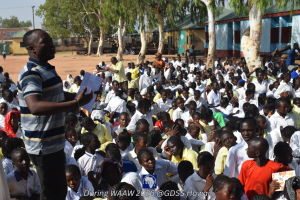
On 19 and 20 November 2026, CFID returned to four schools in Jalingo: GDSS Magami, GDSS Howai, GDSS Nukkai and Eastfield Imperial School. In each, we held interactive sessions on the safe use of medicines as a way of preventing antimicrobial resistance (AMR). We also reconnected with the AMR Champions we had trained in these schools, to learn how they have sustained peer-to-peer education since their training.
The messages we shared
The sessions focused on everyday choices that anyone can make. Students were told never to share medicines, and this applies to every class of antimicrobial: antibiotics, which act against bacteria; antivirals, against viruses; antifungals, against fungi; and antiparasitics, against parasites such as those that cause malaria. A drug that helped someone else may be wrong for you, and misuse is one of the surest ways to encourage resistance.
Prevention was the second theme. Regular handwashing and clean surroundings stop infections from spreading, and fewer infections mean fewer occasions when antimicrobials are needed at all. When treatment is necessary, students learned that the dose must be completed exactly as prescribed by the physician or pharmacist, even if symptoms disappear early. They were also reminded never to self-medicate, and to test first before treatment, so that the right medicine is used only when a proper diagnosis confirms the need.
Each session ended with a call to action: to become an AMR Champion and carry these messages to families, neighbours and communities.
Why this matters
 AMR occurs when bacteria, viruses, fungi and parasites no longer respond to the medicines intended to treat them. Bacterial AMR is already associated with more than 4.7 million deaths annually. Without urgent action, it could cause up to 39 million deaths by 2050 and cost the global economy more than US$3.4 trillion each year, with low- and middle-income countries affected most. WHO’s Regional Director for Africa has urged everyone to choose one concrete action this week, sustain it through the year, and encourage others to act.
Building on CFID’s work in Nigeria
The school visits build on years of stewardship work across the country. CFID’s Community Antimicrobial Stewardship programme reached 63 schools across six states and 48 communities, trained 63 teachers and 252 peer educators, and reached more than 116,000 people through radio and television. In a reported assessment of 582 patients, antibiotic-course completion was 86.6% in the intervention group compared with 47.1% in the monitoring group. These are project-reported findings rather than a population-level estimate, but they show what peer-led education can achieve. The work, titled “Community Stewardship Across Six Nigerian States,” is featured among 34 global stories in the 2026 WHO Civil Society Task Force publication on AMR.
In hospitals, CFID’s stewardship studies covered 14 hospitals in the adult programme and seven in the paediatric programme, and the organisation has contributed technical input to Nigeria’s AMR National Action Plan 2.0 and the National Antimicrobial Stewardship Strategy.
What comes next
CFID will continue to support the trained school AMR Champions and teacher focal persons, track school follow-up and the reach of the messages, and connect schools, medicine vendors, hospitals and other One Health actors so that responsible medicine use becomes the norm.
What you can do today
 Parents can stop giving leftover medicines to children or neighbours. Teachers can invite health educators to run AMR sessions in their schools. Pharmacists and health workers can counsel every patient to complete their course. Everyone can share this story and choose one of the actions above to practise this week. Together, we can protect effective antimicrobials for future generations.
To partner with CFID on AMR education in schools or communities, please contact us through our website.